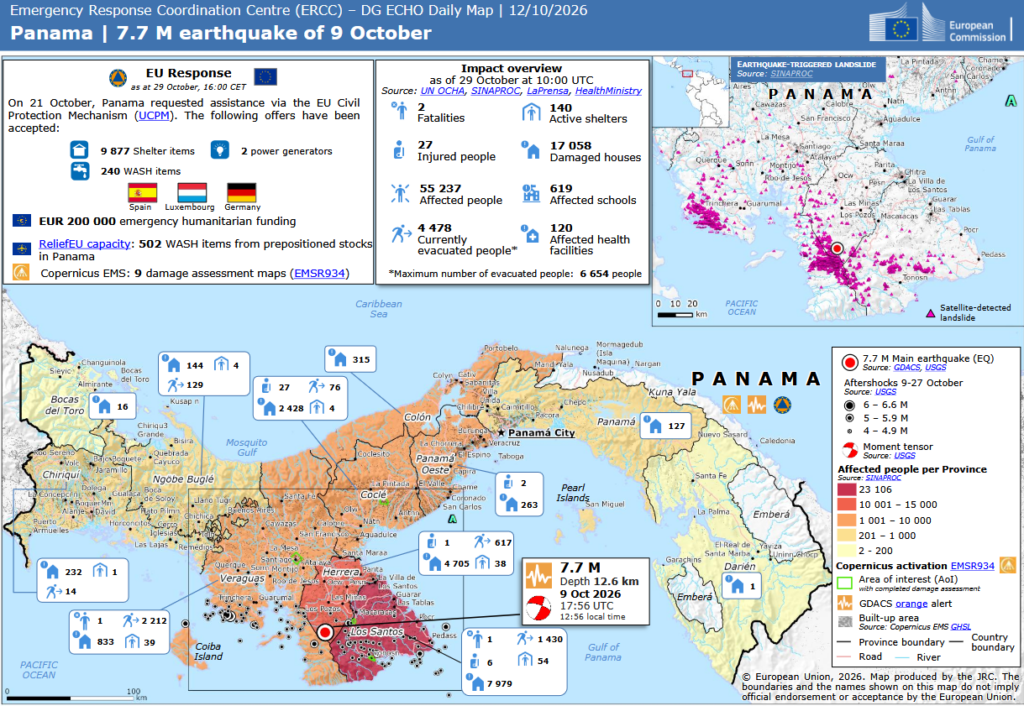
On 9 October 2026, at 12:56 local time, a powerful magnitude 7.7 earthquake struck Panama’s Azuero Peninsula at a shallow depth of approximately 13 kilometres. The epicentre was located near Pitaloza Arriba in Herrera province, with tremors felt across much of the country and in neighbouring states. An initial tsunami warning was later lifted, although seawater inundated homes on Isla Cañas, prompting precautionary evacuations.
The provinces of Veraguas, Los Santos, Herrera and Coclé were the most severely affected. The earthquake caused extensive damage to housing, schools, health facilities, roads and bridges, disrupting essential services and access to affected communities. As of 23 October, authorities reported two fatalities, 27 injuries and more than 35,000 people affected. More than 2,300 homes were destroyed and over 6,000 sustained partial damage, while thousands of people sought shelter in temporary accommodation centers.
Recovery efforts have been further complicated by damaged infrastructure, landslides and interruptions to drinking water, electricity and telecommunications services, particularly in remote and rural communities. Hundreds of education centers and health facilities were also impacted, highlighting the scale of humanitarian needs across the affected provinces.
In support of the national response, emergency.lu mobilized relief equipment from its humanitarian stockpile and deployed assistance to Panama. The shipment included eight multipurpose tents, each providing 48 square meters of covered space, offering flexible facilities for emergency shelter, coordination activities or community services in affected areas.
To ensure a reliable power supply for response operations, emergency.lu also provided two 30 kVA diesel generators. These assets contribute to restoring critical capabilities in areas where infrastructure has been damaged and support humanitarian actors working to assist affected populations.